Blog
12/11/2025
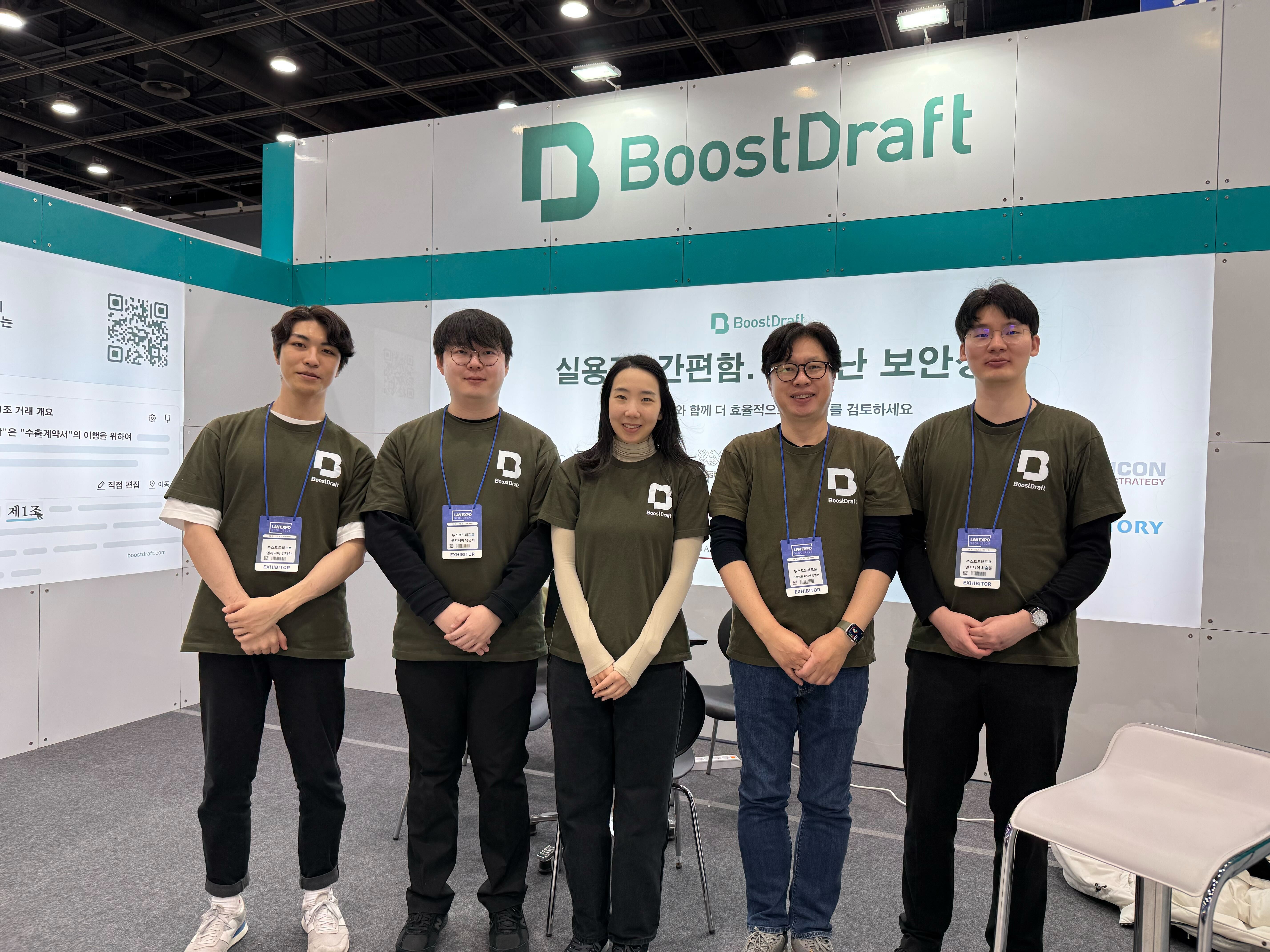
Legal Expo Seoul 2025 made one thing unmistakably clear: Korea’s legal industry is no longer in the “curious about legal tech” phase. It’s in the evaluation and adoption phase.
Held at the aT Center in Yangjae-dong, LES brought together legal tech vendors, law firms, in-house teams, public-sector groups, and technology leaders. The conversations this year were strikingly consistent: Will attorneys actually use this? Will it fit into real workflows? Can we adopt it without disruption?
What stood out most, though, wasn’t the technology itself; it was the way people talked about it. Instead of abstract curiosity or futurist speculation, conversations revolved around something much more grounded: whether a tool could make legal work meaningfully easier. Attendees weren’t looking for the flashiest ideas. They were looking for technology that felt usable the moment they touched it.
That shift toward practicality shaped nearly every interaction we had at the BoostDraft booth. Attorneys and legal-ops teams responded immediately to tools that reduced friction rather than added complexity — especially those that worked directly inside Word, where their work already lives. The reaction wasn’t theoretical; it was visceral: “Oh, this actually fits how we work.”
LES wasn’t just a showcase of innovation. It was a real-time snapshot of a legal market shifting from exploration to application — a market ready for technology that delivers immediate, intuitive value.
Big Picture Signals from the Expo
From Market to Industry
The theme of the first day — “Beyond Market, Toward Industry” — captured a meaningful shift in Korea’s legal landscape. Instead of treating legal technology as a collection of interesting tools, the expo framed it as the connective infrastructure of a fully developed industry. The message was unmistakable: legal tech is no longer an experimental add-on. It is part of the core operating fabric of modern legal practice.
Diverse Attendees
The exhibition floor featured roughly 50 companies spanning every part of the emerging ecosystem. Traditional legal tech vendors shared space with digital-transformation consultancies, compliance tech providers, branding and marketing support services, and cloud and AI infrastructure partners. The mix reinforced how many adjacent sectors now participate in building Korea’s legal services industry, and how quickly the ecosystem is expanding.
That diversity was reflected in the audience as well. Law firms of all sizes, corporate legal departments, public institutions, and technology teams all walked the floor, often with very targeted goals in mind. Even students and early-career professionals came through to understand how the profession is evolving. Far from a niche gathering or a startup-focused showcase, this year’s expo felt like a cross-section of the entire legal ecosystem, each group looking for technology that can be adopted in real workflows, not just admired in concept.
What’s Changed: From Curiosity to Practicality
One of the clearest themes at this year’s expo was a shift away from novelty-driven exploration and toward pragmatic evaluation. Attendees weren’t asking, “What’s new?” They were asking, “Will this work the way lawyers actually work?”
Across conversations, the criteria repeated almost verbatim: Will attorneys adopt this quickly? Does it fit inside Word? Will it integrate with our stack? How much training does it require? The excitement wasn’t around abstract AI capabilities; it was around tools that delivered value without adding complexity.
This shift aligned closely with what visitors highlighted at the BoostDraft booth. The familiarity of a Word-based interface, the ability to automate review without changing workflows, and the immediate clarity of benefits resonated strongly. Instead of hypothetical use cases, attendees responded to tools that reduced friction on day one.
In short: legal teams in Korea aren’t shopping for innovation for its own sake. They’re looking for solutions that feel intuitive, adoptable, and grounded in real practice — a sign that the market is maturing not just in what it offers, but in how it chooses.
Experience on the Ground — What Resonated
Across all three days of the expo, one pattern stood out: the strongest reactions came when attendees immediately understood how a tool would fit into their daily work. At the BoostDraft booth, that happened quickly. Attorneys would try a feature, recognize the familiar Word environment, and respond with some version of, “Oh, this just works.” The simplicity of the workflow was often the first thing they commented on.
What was especially encouraging was the range of interest. Public-institution representatives, in-house legal teams, and private-practice attorneys all gravitated toward the same qualities: ease of learning, clarity of value, and minimal disruption to existing processes. This enthusiasm wasn’t limited to tech-forward firms; it was a broad consensus that usability now matters as much as capability.
Many attendees noted that the bar has shifted: legal teams are tired of tools that look impressive in a demo but falter in real workflows. They’re looking for technology that removes cognitive load, not adds to it.
A highlight of the week was BoostDraft’s inclusion in the Curated Tour, which brought a high-influence group of government officials, in-house leaders, and firm attorneys through select booths. Their response reinforced what we heard throughout the event: when a solution is intuitive and immediately useful, adoption stops being a hurdle and becomes an expectation.
Conclusion
Taken together, the signals from this year’s expo suggest that Korea’s legal sector is moving into a genuine adoption phase, not an exploration phase. Interest in legal technology is no longer theoretical; teams are looking for tools they can deploy quickly, teach easily, and rely on under the real pressures of legal practice.
LES 2025 felt like more than a showcase. It felt like a turning point. The conversations were deeper, the evaluation criteria clearer, and the appetite for practical, intuitive solutions unmistakable. The legal tech tide in Korea isn’t just rising anymore; it’s breaking over the threshold.
If you’d like to see what intuitive, Word-based legal tech looks like in action — the kind that fits seamlessly into real workflows and reduces friction from day one — we’d be happy to show you. Book a demo today.

Recent Post