Blog
04/13/2026
In our previous post, we looked at five operational clauses that help prevent disputes before they happen by defining scope, performance expectations, and responsibilities. Those clauses focus on how work gets done day to day: what is delivered, how it is measured, and what each party is expected to contribute.
But even when scope and performance are clearly defined, disputes can still arise if there is no structure for communication, timing, or decision-making as the relationship evolves.
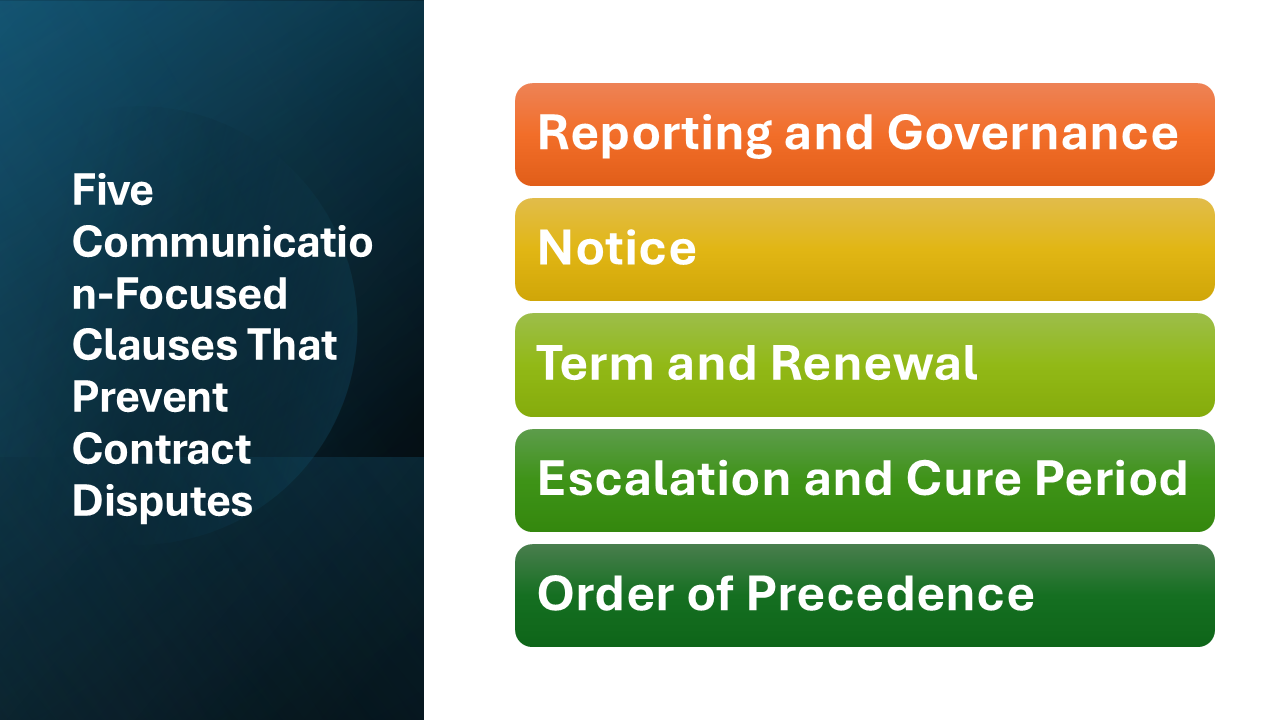
In this post, we turn to another set of operational clauses that address those challenges. These provisions — covering reporting and governance, notice, renewal, escalation, and order of precedence — help ensure that issues are communicated clearly, handled consistently, and resolved before they escalate into larger disputes.
Reporting and Governance
What it does
Reporting and governance clauses define how the parties communicate, coordinate, and manage the business relationship over time. These clauses are common in longer-term services, outsourcing, and enterprise agreements. They typically establish regular meetings, reporting obligations, key contacts, and escalation paths. In more complex agreements, they may also create formal governance structures such as steering committees or project management teams.
Where disputes usually arise
Disputes often arise when there is no clear structure for communication or oversight. Issues may go unaddressed because they are not raised early, or because the right stakeholders are not involved. For example, a delivery issue may persist for weeks because it is only discussed informally between junior team members, while senior stakeholders remain unaware. Disagreements can also arise when expectations about reporting, progress tracking, or issue resolution are not aligned.
How to prevent disputes
Define a clear communication structure at the outset of the relationship. Identify key contacts on both sides and specify how often the parties will meet to review progress. Establish regular reporting requirements, including what will be reported and how. Include a defined escalation path so that unresolved issues are raised to appropriate stakeholders in a timely manner. Make sure governance processes are practical and align with how the teams actually operate.
Typical provisions
- Designated points of contact for each party
- Regular meeting cadence (e.g., weekly, monthly)
- Reporting requirements and formats
- Governance structure (e.g., project team, steering committee)
- Escalation path for unresolved issues

Notice
What it does
Notice clauses define how formal communications under the agreement must be delivered and when those communications are considered effective. These clauses typically apply to important actions such as termination, breach notices, renewals, and amendments. The clause specifies permitted delivery methods (for example, email, courier, or certified mail), designated contact information, and when notice is deemed received.
Where disputes usually arise
Disputes often arise when one party believes it has provided notice, but the other claims the notice was not valid under the contract. For example, a party may send a termination notice by email, while the agreement requires notice by courier or to a specific address. Issues also arise when contact details are outdated or when the contract does not clearly define when notice is deemed received, leading to disagreements about timing for deadlines, cure periods, or termination rights.
How to prevent disputes
Clearly define permitted methods of notice and ensure they reflect how the parties actually communicate in practice. Specify exact contact details for each party and include a process for updating those details over time. Define when notice is deemed received, including for email if it is allowed. Align the notice clause with other provisions that rely on timing, such as termination, renewal, and cure periods, so that deadlines are clear and enforceable.
Typical provisions
- Permitted methods of delivery (e.g., email, courier, certified mail)
- Designated addresses or contact details
- Rules for updating notice information
- When notice is deemed received
- Application to termination, breach, or renewal notices
Term and Renewal
What it does
Renewal clauses define what happens when the initial term of the agreement ends. These clauses typically specify whether the contract renews automatically, renews only with mutual agreement, or terminates unless one party takes action. Auto-renewal provisions often extend the agreement for successive terms unless one party provides notice of non-renewal within a defined window.
Where disputes usually arise
Disputes often arise when one party is unaware that the agreement has automatically renewed or misses the deadline to opt out. For example, a customer may assume a contract will expire at the end of the term, only to find that it has renewed for another year because notice was not provided in time. Disagreements also occur when renewal pricing, term length, or changes to terms are not clearly defined, leading to confusion about what applies in the renewal period.
How to prevent disputes
Clearly define whether the agreement renews automatically or requires affirmative action. Specify the length of the renewal term and any changes to pricing or terms upon renewal. Include a clear notice window for non-renewal and align it with the notice clause. Make sure the timing is practical and visible to both parties so that deadlines are not easily missed. If auto-renewal is used, consider requiring advance reminders or internal tracking to ensure the clause operates as intended.
Typical provisions
- Renewal structure (automatic versus mutual agreement)
- Length of renewal term
- Notice period for non-renewal
- Renewal pricing or adjustment terms
- Application of existing or updated terms upon renewal
Escalation and Cure Period
What it does
Escalation and cure period clauses define how issues are handled when one party believes the other has failed to meet its obligations. These clauses typically require the parties to escalate issues internally before taking formal action and provide a defined period for the breaching party to fix the problem. Cure periods are often tied to termination rights, meaning a party cannot terminate the agreement for breach unless the issue remains unresolved after the cure period expires.
Where disputes usually arise
Disputes often arise when one party moves too quickly to terminate the agreement or escalate a minor issue into a formal breach. For example, a customer may attempt to terminate a contract over a service issue without giving the provider a meaningful opportunity to resolve it. Disagreements also occur when the contract does not clearly define what constitutes a breach or how long a party has to cure it. Without a structured process, small operational issues can escalate into larger disputes or even litigation.
How to prevent disputes
Define a clear escalation path for resolving issues before formal remedies are invoked. Specify who issues should be escalated to and in what order, such as from project managers to senior stakeholders. Include a reasonable cure period that gives the breaching party time to fix the issue, and define when that period begins. Align the clause with termination provisions so that termination rights are only triggered after the cure period expires. This helps ensure that issues are addressed constructively before the relationship breaks down.
Typical provisions
- Internal escalation process and hierarchy
- Definition of breach or triggering events
- Cure period length (e.g., 10, 30 days)
- Requirement to provide notice of breach
- Link between cure period and termination rights
Order of Precedence
What it does
Order of precedence clauses define which document controls when there is a conflict between different parts of the agreement. In many contracts, especially enterprise agreements, the full agreement is made up of multiple documents such as a master services agreement (MSA), statements of work (SOWs), service level terms, and order forms. This clause establishes a hierarchy so that if two provisions are inconsistent, there is a clear rule for which one takes priority.
Where disputes usually arise
Disputes often arise when different documents say different things about the same issue. For example, an SOW may include a delivery timeline that conflicts with the MSA, or an order form may include pricing terms that differ from the main contract. Without a clear order of precedence, each party may rely on the version that favors its position. These conflicts can be difficult to resolve and often lead to prolonged negotiations or disputes over interpretation.
How to prevent disputes
Include a clear and explicit order of precedence clause that lists all relevant documents in priority order. Make sure the hierarchy reflects how the agreement is intended to operate in practice. Review all incorporated documents carefully to identify and resolve conflicts before signing. Where possible, avoid unnecessary duplication of terms across documents to reduce the risk of inconsistency. If different documents are meant to override specific provisions, state that clearly.
Typical provisions
- List of governing documents (e.g., MSA, SOW, service-level agreement, order form)
- Priority order in case of conflict
- Clarification of which terms control specific topics
- Reference to incorporated schedules or exhibits
Conclusion
Many contract disputes are not caused by a single major issue, but by a series of smaller breakdowns in communication, timing, and process. Governance structures, notice requirements, renewal terms, escalation procedures, and document hierarchy all play a role in how those situations are handled. When these clauses are clearly defined and aligned, they help ensure that issues are surfaced early, addressed appropriately, and resolved before they escalate.
Together with the clauses covered in part one of this series, these operational provisions form the backbone of how an agreement functions over time. They provide structure around communication, clarify expectations at key moments in the contract lifecycle, and reduce ambiguity when something goes wrong.
If you’re looking for ways to catch inconsistencies, missing provisions, or drafting issues before they turn into larger problems, schedule a demo of BoostDraft to see how it streamlines contract review directly in Microsoft Word.

Recent Post