Blog
04/13/2026
Most contract disputes do not start with indemnification or limitation of liability. They start with unclear scope, missed expectations, delays, or disagreements about responsibilities and timelines. In other words, they start with operational issues.
The clauses that prevent many of these disputes are operational clauses that define how the agreement actually works day to day. When these clauses are clear, relationships run smoothly. When they are vague or inconsistent, even small issues can turn into major disputes.
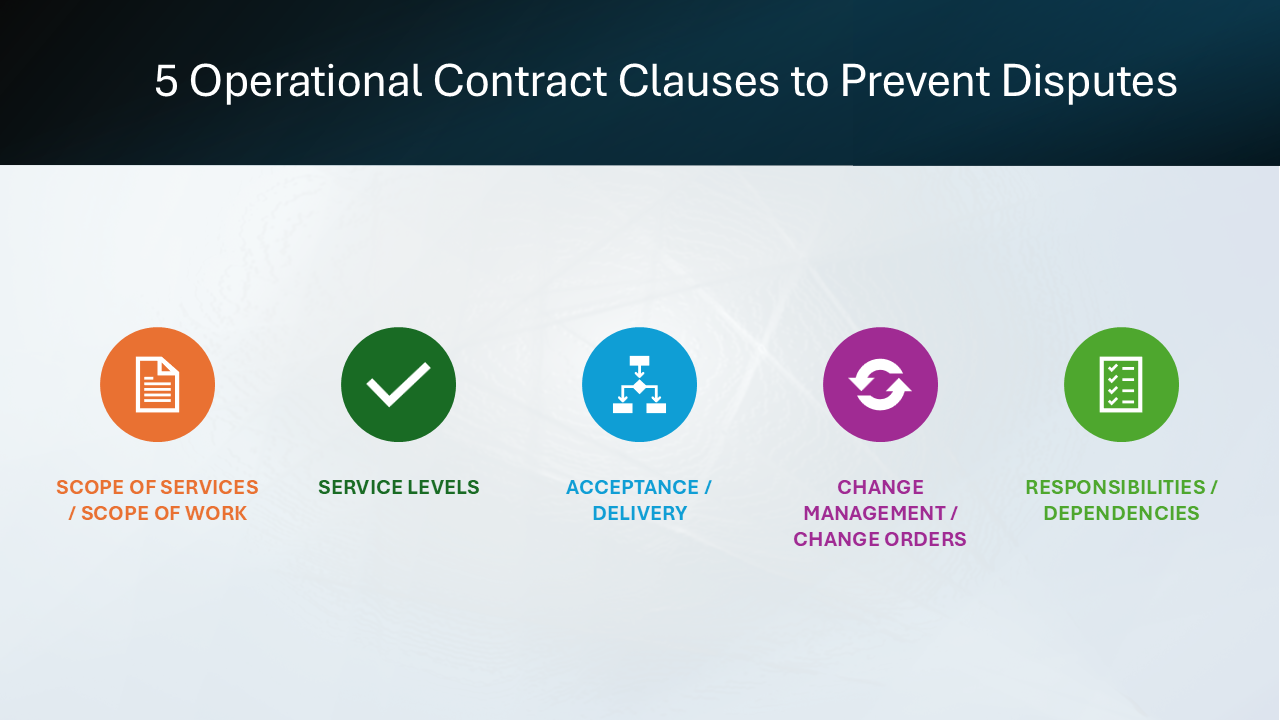
In this post, we look at five operational clauses that often prevent disputes before they happen.
Scope of Services / Scope of Work
What it does
The scope of services clause defines what work will be performed under the agreement, what deliverables are included, and what the parties expect from each other. In services, consulting, development, and outsourcing agreements, the scope is often defined in a statement of work (SOW) attached to the main agreement. This clause (or appendix) effectively sets the boundaries of the business relationship by defining what is included in the project and, just as importantly, what is not included.
Where disputes usually arise
Many contract disputes begin with disagreements about scope. One party may believe certain work was included in the original agreement, while the other considers that work outside the scope and subject to additional fees or a separate project. Disputes also arise around timelines, deliverables, and assumptions. For example, a vendor may assume the customer will provide data or approvals within a certain timeframe, while the customer assumes the vendor will proceed regardless. When these assumptions are not documented clearly, delays and disagreements are almost inevitable.
How to prevent disputes
Define deliverables, timelines, assumptions, and exclusions clearly and in writing. Describe what success looks like for each deliverable, not just the general services to be provided. Specify customer responsibilities and any dependencies that affect timelines. Clearly state what is out of scope so that additional work can be handled through change orders rather than informal requests. When possible, tie the scope directly to milestones, acceptance criteria, and the change management process so that changes are handled through a defined procedure instead of ad hoc discussions.
Typical provisions
- Description of services
- Deliverables and milestones
- Timeline or project schedule
- Customer responsibilities and dependencies
- Assumptions and exclusions
- Reference to change order process
Service Levels
What it does
Service level clauses (sometimes structured as a separate service level agreement or SLA) define performance standards that a service provider must meet during the term of the agreement. These clauses are common in SaaS, outsourcing, IT services, and support agreements. Service levels typically cover measurable metrics such as system uptime, response times, resolution times, or processing timelines. The clause may also include reporting requirements and service credits or other remedies if performance standards are not met.
Where disputes usually arise
Disputes often arise when service levels are vague, unrealistic, or not clearly measurable. For example, a contract might require “commercially reasonable efforts” to maintain uptime without defining a specific uptime percentage. Disagreements also occur when service levels are measured differently by each party, or when the agreement does not clearly define how downtime, response time, or resolution time is calculated. Another common issue is when service credits are unclear or difficult to apply in practice.
How to prevent disputes
Define service levels using clear, measurable metrics and specify exactly how performance will be calculated. Define key terms such as uptime, downtime, response time, and resolution time. Clarify any exclusions, such as scheduled maintenance or outages caused by the customer’s systems. Include reporting obligations so performance can be tracked consistently. If service credits apply, clearly describe how they are calculated and how they are requested or applied.
Typical provisions
- Uptime percentage or availability targets
- Response and resolution time targets
- Measurement and reporting methods
- Scheduled maintenance exclusions
- Service credits or remedies for failure to meet service levels

Acceptance / Delivery
What it does
Acceptance and delivery clauses define how and when deliverables are provided and how the receiving party confirms that the work meets the agreed requirements. These clauses are common in services, software development, and procurement agreements. They typically outline delivery milestones, acceptance criteria, review periods, and what happens if deliverables are rejected or require rework. The acceptance process is important because it often determines when payment is due and when responsibility for the deliverable transfers.
Where disputes usually arise
Disputes often arise when acceptance criteria are vague or when the contract does not specify how long the receiving party has to review deliverables. One party may believe the work was completed and accepted, while the other believes it was incomplete or defective. Disagreements also occur when there is no clear process for rejecting deliverables or requesting corrections, or when acceptance is delayed indefinitely because no review deadline exists.
How to prevent disputes
Define clear acceptance criteria and review timelines in the agreement. Specify how deliverables will be tested or evaluated and what standards must be met for acceptance. Include a defined review period, after which deliverables are deemed accepted if no rejection is provided in writing. Establish a process for correcting rejected deliverables, including timelines for rework and resubmission. Align acceptance milestones with payment milestones to avoid confusion about when invoices can be issued.
Typical provisions
- Delivery milestones and deadlines
- Acceptance criteria or testing requirements
- Review and acceptance period
- Deemed acceptance if no rejection is provided
- Rework or correction process
- Link between acceptance and payment milestones
Change Management / Change Orders
What it does
Change management clauses define how changes to the scope, timeline, pricing, or deliverables are handled after the agreement is signed. These clauses are especially important in services, development, implementation, and long-term projects where the scope is likely to evolve. The clause typically establishes a formal change order process that requires written approval before additional work begins or timelines are adjusted.
Where disputes usually arise
Disputes often arise when work changes informally over time. A customer may request small changes or additional features, and the service provider may proceed without documenting the impact on timeline or cost. Over time, these small changes can significantly expand the scope of work, leading to disagreements about whether the work was included in the original price or schedule. Disputes also occur when delays are caused by scope changes but the contract does not clearly address how timelines should be adjusted.
How to prevent disputes
Establish a clear change order process that requires written approval for any changes affecting scope, timeline, or pricing. Define what constitutes a change and specify that work outside the original scope must be documented through a change order before the work begins. Require the change order to describe the impact on cost, timeline, and deliverables. Make sure project teams understand that informal requests should be documented, even if the change seems minor at the time.
Typical provisions
- Definition of what constitutes a change
- Requirement for written change orders
- Approval process for scope, pricing, or timeline changes
- Adjustments to milestones or delivery dates
- Impact on fees or payment schedule
Responsibilities / Dependencies
What it does
Responsibilities or dependencies clauses define what each party must do to enable the other party to perform its obligations under the agreement. In many services, implementation, and development agreements, one party’s performance depends on the other party providing information, access, approvals, or resources. This clause clarifies those responsibilities and helps ensure that timelines and obligations are realistic and achievable.
Where disputes usually arise
Disputes often arise when delays occur and each party blames the other. For example, a vendor may miss a delivery deadline because the customer did not provide data, approvals, or system access on time, while the customer believes the vendor simply failed to perform. Without clearly defined responsibilities and dependencies, it can be difficult to determine whether a delay or failure was caused by one party’s performance or the other party’s lack of cooperation.
How to prevent disputes
Clearly define each party’s responsibilities in the agreement, including any information, access, approvals, or resources that must be provided for the project to move forward. Specify timelines for providing inputs or approvals and state that delays caused by one party may extend delivery timelines accordingly. Make sure responsibilities are consistent with the scope, timeline, and acceptance provisions so that obligations and dependencies are aligned across the agreement.
Typical provisions
- Customer obligations to provide information or materials
- Access to systems, facilities, or personnel
- Approval or review timelines
- Dependencies affecting delivery timelines
- Timeline extensions for delays caused by the other party
Conclusion
Many contract disputes do not start with major legal issues. They start with mismatched expectations, unclear responsibilities, or poorly defined processes.
The clauses discussed here — scope of services, service levels, acceptance, change management, and responsibilities — help define how an agreement actually works in practice. When these clauses are clear and aligned, projects tend to run more smoothly and disagreements are easier to resolve. When they are vague or inconsistent, even small issues can turn into larger disputes.
In our next post, we’ll look at additional operational clauses that help prevent disputes.
If you’re looking for ways to review contracts more efficiently and catch issues including inconsistent obligations, missing definitions, or drafting errors before they cause problems, schedule a demo of BoostDraft to see how it streamlines contract review for legal teams like yours.

Recent Post