
Blog
05/07/2026
Previously, we looked at common contract negotiation mistakes that business teams make: issues such as looping in the legal team too late, skipping written alignment, or prioritizing speed over mutual understanding. Those challenges often set the stage for friction before drafting even begins.
But negotiation involves more than just business terms and stakeholders. Lawyers play an equally important role in how smoothly a deal progresses and how effectively each side manages risk. Even with strong business alignment, certain habits and approaches on the legal side can slow negotiation down, create unnecessary complexity, or shift focus away from what matters most.
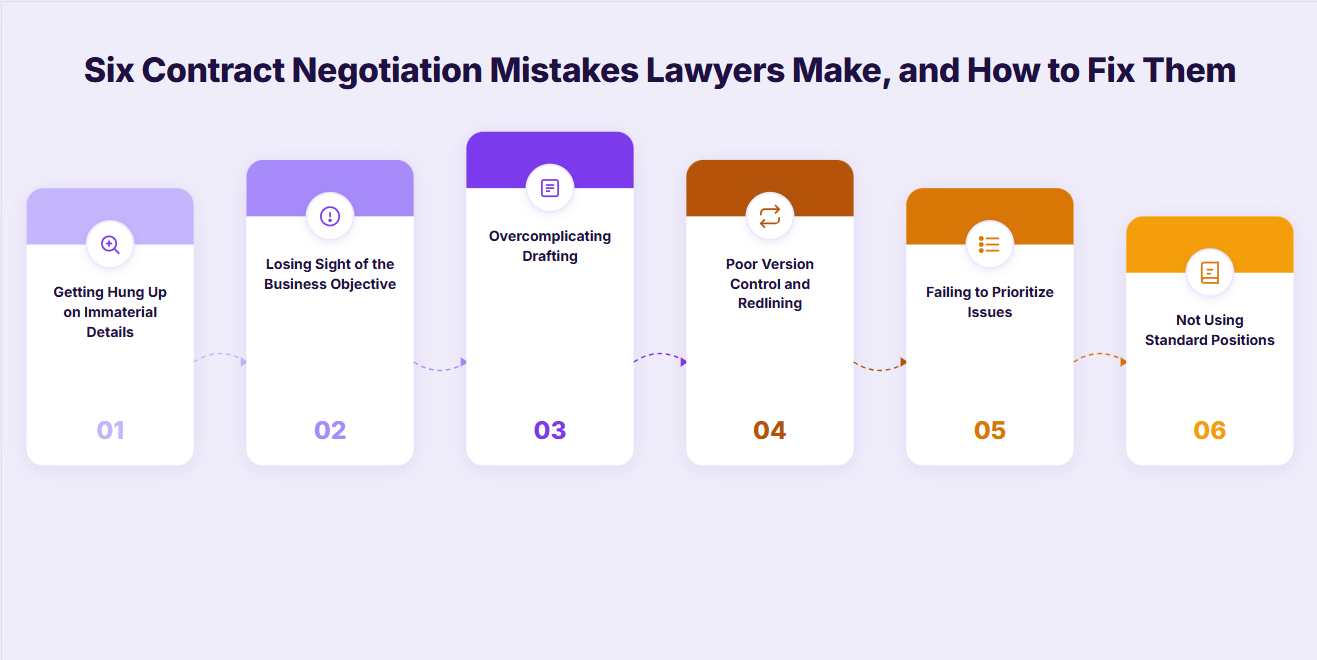
In this post, we look at six common mistakes lawyers make during contract negotiation, and how small adjustments can lead to more efficient, practical, and business-aligned outcomes.
Getting Hung Up on Immaterial Details
How It Happens
Lawyers often spend significant time refining language that doesn’t meaningfully change the substance of a clause. This can include stylistic preferences, minor wording changes, or negotiating phrasing that has little impact on risk or execution. For example, parties may go back and forth on whether an obligation should be “reasonable efforts” versus “commercially reasonable efforts,” even when the practical difference is minimal.
Why It Becomes a Problem
This slows down negotiation and creates unnecessary friction with counterparties. It can make the process feel overly rigid or adversarial, especially when the other party doesn’t see the issue as meaningful. Furthermore, it distracts from higher-impact issues that actually affect risk, economics, or performance.
How to Avoid It
Prioritize substance over style. Focus on whether a change meaningfully affects outcomes, not whether it reflects a preferred drafting approach. Be willing to concede on points that do not materially impact the deal so attention stays on what matters.
Losing Sight of the Business Objective
How It Happens
Many lawyers focus primarily on minimizing legal risk without fully considering the broader business context. This can show up as pushing back on terms that are commercially important to the deal or applying standard positions without adapting them to the specific situation. For example, a lawyer may resist a concession that carries some risk but is critical to closing the deal or maintaining the relationship.
Why It Becomes a Problem
When legal advice is disconnected from business priorities, it can slow down or even derail deals unnecessarily. It may also create tension with business teams or clients, who are trying to balance risk with revenue, timing, and strategic goals. Over time, this can reduce trust in legal input if it is seen as blocking progress rather than enabling it.
How to Avoid It
Anchor legal analysis in the business objective. Understand what the client or business team is trying to achieve and how much risk is acceptable in that context. Frame advice in terms of tradeoffs, not just risk, and focus on helping the deal move forward while managing exposure appropriately.

Overcomplicating Drafting
How It Happens
Some lawyers introduce unnecessary complexity into contracts through dense language, over-customization, or overly detailed provisions. Instead of using clear, standard language, they expand clauses to cover every possible scenario or tailor them in ways that are not strictly necessary for the deal. This often reflects a desire to be thorough or anticipate edge cases, but it often instead results in contracts that are harder to read and navigate.
Why It Becomes a Problem
Overly complex drafting makes contracts more difficult to negotiate, as counterparties need more time to review and respond. It can also lead to confusion, both during negotiation and after execution, when business teams are trying to understand their obligations. In some cases, complexity introduces inconsistencies or unintended consequences. The result is a document that is harder to work with at every stage: negotiation, execution, and performance.
How to Avoid It
Keep drafting as simple and clear as possible while still addressing material risks. Use standard language where appropriate and avoid over-customizing unless there is a clear need. Focus on making the contract understandable to both legal and business stakeholders so they can use it effectively in practice.
Poor Version Control and Redlining Practices
How It Happens
Negotiators often have to manage contract drafts across separate email threads, shared drives, and local files without a clear system for version control. Multiple versions of the same document circulate at once, often with different edits and comments. Teams may track changes inconsistently or fail to confirm which version is the current draft. This leads to one party revising an outdated version while the other continues negotiating a different draft, creating parallel edit streams and miscommunication.
Why It Becomes a Problem
This creates confusion and slows down negotiation. Lawyers may miss changes, inadvertently overwrite edits, or waste time responding to outdated language. Conflicting edits can require rework, and lost changes can introduce risk if key revisions don’t make it into the final document. It also creates friction with counterparties, who may lose confidence in the process if drafts are inconsistent or unclear.
How to Avoid It
Maintain a single source of truth for each draft and confirm which version is active before making edits. Use consistent redlining practices and avoid circulating multiple versions simultaneously. Centralize document sharing where possible and ensure all parties work from the same file. Clear version control keeps negotiations efficient and reduces the risk of errors.
Failing to Prioritize Issues
How It Happens
This happens when lawyers approach negotiation without clearly distinguishing between critical issues and lower-impact points. They treat all comments and suggested edits as equally important. This often shows up in long redlines that include a mix of major risk items and minor preferences, without clear indication of what actually matters.
Why It Becomes a Problem
When everything is treated as important, it becomes harder for the other side to understand what truly matters. This slows down negotiation, as counterparties spend time responding to low-impact points while missing the significance of higher-priority issues. It also makes it more difficult to make strategic concessions, since there is no clear framework for what can be traded and what cannot. The result is a less efficient negotiation process and a higher risk of misalignment on key terms.
How to Avoid It
Prioritize issues based on their impact on risk, cost, and execution. Clearly distinguish between must-have positions, preferred outcomes, and fallback options. Focus negotiation efforts on the issues that matter most and be prepared to concede on lower-priority points. This helps streamline discussions and makes it easier to reach agreement on critical terms.
Not Using Standard Positions
How It Happens
Lawyers approach each negotiation from scratch instead of relying on established positions. They may draft new language for common clauses, take inconsistent positions across similar deals, or rely on personal preference rather than a defined approach. This often happens when there is no shared playbook or template, or when teams don’t consistently follow those internal standards.
Why It Becomes a Problem
This leads to inefficiency and inconsistency. Lawyers spend time reinventing language that already exists, and counterparties receive mixed signals when positions vary from one deal to another. It can also slow negotiation, as previously resolved issues get rehashed from one negotiation to the next. Over time, this makes it harder to build predictable, repeatable processes.
How to Avoid It
Use standard positions and playbooks for common issues. Rely on proven language where appropriate and adapt it only when necessary. Maintain consistency across deals so negotiations move faster and expectations stay clear.
Conclusion
Many contract negotiation issues are not caused by a lack of legal expertise. They stem from habits and approaches that, while well-intentioned, can slow deals down and create unnecessary friction.
Improving these practices does not require a complete change in approach. Small adjustments in how you prioritize issues, structure drafts, and manage the negotiation process can lead to faster turnaround times, clearer agreements, and better outcomes for clients and business teams.
If you’re looking to reduce friction in contract drafting and review so you can focus more on the substance of negotiation, schedule a demo of BoostDraft to see how it helps legal teams like yours work more efficiently directly inside Microsoft Word.
Recent Post