Blog
05/27/2026
Even experienced lawyers miss contract errors during final review. In many cases, the problem is not legal expertise. It is the complexity of modern contract workflows: multiple drafts, disconnected review tools, AI-generated revisions, late-stage edits, and growing time pressure across legal teams.
As contracts move through negotiation, review, and execution, small inconsistencies can survive surprisingly sophisticated review processes. Defined terms become outdated, cross-references shift, formatting breaks, and last-minute revisions bypass full scrutiny. AI tools can accelerate drafting and review, but they can also introduce new risks when generated language is accepted too quickly or inserted without sufficient verification.
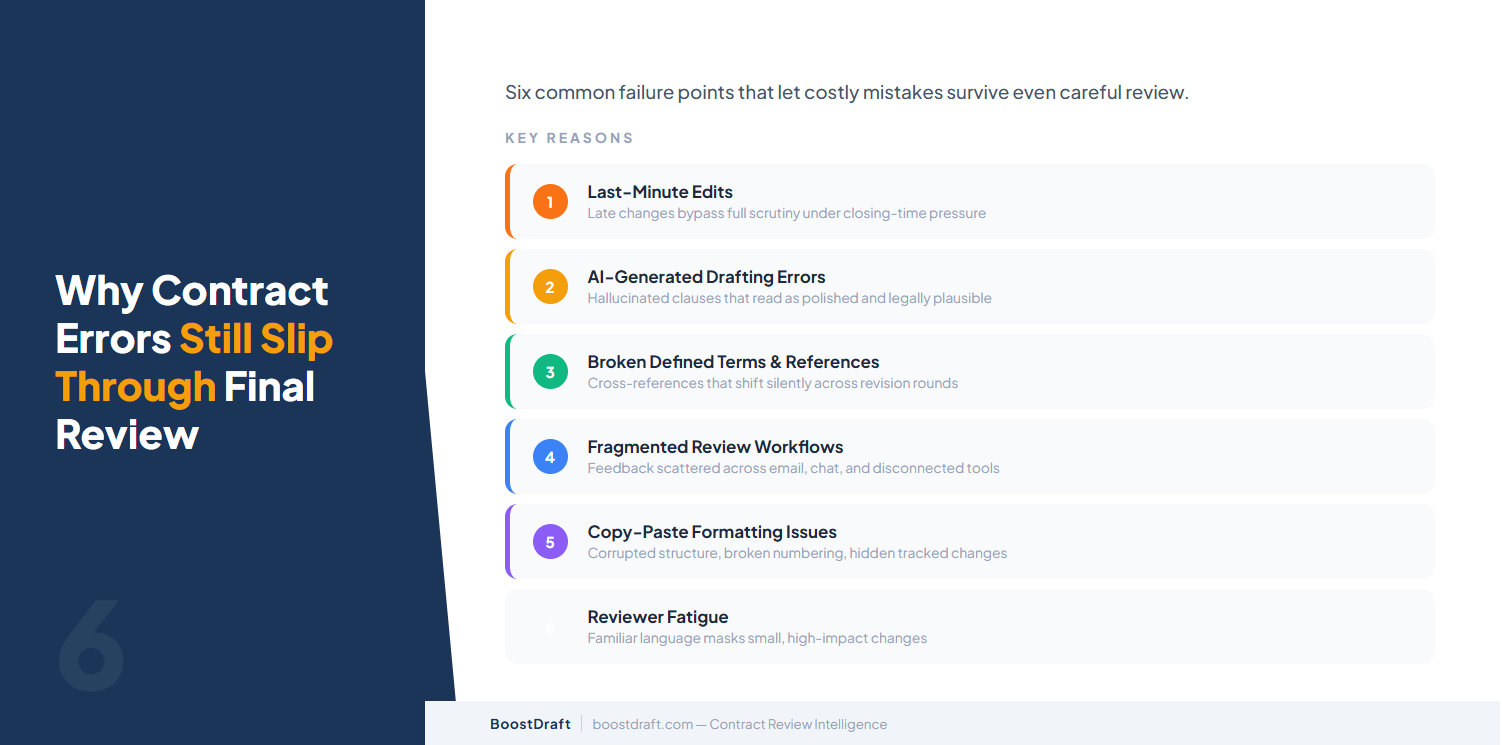
This article examines six common reasons contract errors still slip through final review and how legal teams can reduce those risks through more consistent review workflows and verification processes.
Common Contract Errors That Survive Final Review
- Last-minute edits
- AI-generated drafting errors
- Broken defined terms and references
- Fragmented review workflows
- Copy-paste formatting issues
- Reviewer fatigue
1. Last-Minute Changes Never Receive Full Review
Many contract errors survive final review because changes are made too late in the process to receive the same level of scrutiny as earlier drafts. Business stakeholders, counterparties, or even lawyers may insert “small” revisions shortly before signature: updated pricing language, modified timelines, revised operational terms, or copied language from another agreement. In some cases, the changes occur outside the normal review workflow entirely, such as through email comments, side conversations, or untracked edits.
Why It Gets Missed
These late-stage revisions are easy to miss because reviewers often assume the remaining changes are minor or already vetted. Time pressure also plays a major role. Once negotiations appear close to completion, teams tend to focus on execution and closing rather than conducting another comprehensive review of the document. The final draft may therefore receive only a partial or targeted review instead of a full re-review.
Why It Matters
This matters because even small late-stage edits can materially affect risk allocation, operational obligations, or commercial terms. A single overlooked revision can create inconsistencies elsewhere in the agreement or unintentionally override previously negotiated language.
How to Prevent It
Reduce this risk by establishing clear rules around late-stage edits, requiring tracked changes for all revisions, and defining when a document must return for full legal review before signature.
2. AI-Generated Clause Language Introduces Hallucinations
AI drafting tools can generate contract language that appears polished and legally plausible while still containing substantive errors. These issues may include fabricated obligations, inconsistent definitions, inaccurate cross-references, unsupported legal concepts, or clause language that does not align with the rest of the agreement. In some cases, generic AI tools may also overwrite carefully negotiated language with generalized wording that changes the meaning or risk allocation of a provision.
Why It Gets Missed
AI-generated errors are often difficult to detect because the language usually sounds confident and professionally written. Reviewers may focus on whether the clause reads smoothly rather than whether it is internally consistent, operationally workable, or aligned with the negotiated deal terms. Time pressure and review fatigue can worsen the problem, especially when AI-generated text is inserted late in the drafting process or blended into existing language without clear visibility into what changed.
Why It Matters
Hallucinated or inaccurate clause language can introduce operational confusion, conflicting obligations, or unintended legal exposure. Because the language often appears credible, these issues may survive multiple rounds of review before creating problems during implementation, enforcement, or dispute resolution.
How to Prevent It
Treat AI-generated language as draft material requiring full legal review rather than as verified output. Require reviewers to validate AI-generated clauses against the rest of the agreement, approved templates, and internal playbooks. Limit unsupervised insertion of AI-generated text into near-final drafts, especially for heavily negotiated or operationally sensitive provisions.
3. Defined Terms Become Obsolete and Cross-References Shift
Contract drafts often evolve through multiple rounds of revisions, clause reorganization, and template modifications. As language moves or provisions are deleted, defined terms can become outdated, inconsistent, or disconnected from the surrounding agreement. Cross-references may also break over time, pointing to deleted sections, incorrect exhibits, or provisions that have been renumbered during negotiation. These errors are especially common in large agreements assembled from multiple templates or prior drafts.
Why It Gets Missed
Defined term and cross-reference issues are difficult to catch manually because they are structural rather than substantive. A reviewer may focus closely on negotiated business terms while overlooking whether a capitalized term is still defined correctly elsewhere in the document. Similarly, section references that were accurate earlier in the drafting process may become incorrect after revisions, clause insertions, or formatting changes. These problems become harder to detect as agreements grow longer and more heavily revised.
Why It Matters
Outdated definitions and broken cross-references can create ambiguity, operational confusion, and disputes over interpretation. In some cases, they make key obligations difficult to enforce or cause parties to rely on inconsistent language across the agreement.
How to Prevent It
Review defined terms and cross-references systematically rather than relying solely on manual proofreading. Use standardized drafting workflows and verification tools to identify undefined terms, inconsistent capitalization, duplicate definitions, and broken references before signature. Re-check document structure after major revisions or template integrations instead of assuming earlier references remain accurate.
4. Review Workflows Fragment Across Disconnected Tools
Modern contract review often takes place across too many disconnected systems and communication channels. Drafts circulate through email while comments appear in chat messages, document management systems, shared drives, browser-based AI tools, and separate approval platforms. Different stakeholders may review different versions of the agreement or provide feedback outside the primary drafting workflow entirely. Over time, the negotiation process becomes fragmented across multiple locations with no clear source of truth.
Why It Gets Missed
Fragmented workflows make it difficult for reviewers to maintain visibility into what changed, who approved it, and whether all feedback was incorporated consistently. Comments may remain buried in email threads, edits may be applied inconsistently across drafts, and approvals may occur without a complete view of the current document state. Reviewers also lose context when moving repeatedly between disconnected tools, increasing the likelihood that small inconsistencies or overlooked revisions survive final review.
Why It Matters
Disconnected review workflows create operational blind spots. Teams may negotiate from outdated drafts, overlook unresolved comments, or accidentally reintroduce previously removed language. These process failures slow negotiations and increase the risk that material issues remain unresolved at signature.
How to Prevent It
Centralize contract review workflows as much as possible. Maintain a clear source of truth for drafts, comments, approvals, and revision history. Reduce reliance on fragmented communication channels for substantive contract feedback, and establish consistent review processes so stakeholders work from the same document and workflow throughout negotiation.
5. Copy-Pasting Introduces Formatting and Structural Errors
Contract drafting frequently involves reusing language from templates, prior agreements, negotiation fallback documents, or external sources. During fast-moving negotiations, lawyers and business stakeholders may copy and paste clauses, schedules, or defined terms into a working draft without fully reconciling formatting, numbering, document structure, or surrounding language. These edits can introduce duplicated sections, broken numbering sequences, inconsistent formatting, hidden tracked changes, or references to exhibits and clauses that no longer exist.
Why It Gets Missed
Formatting and structural errors are easy to overlook because reviewers naturally focus more attention on substantive legal and commercial terms. Copy-pasted language may also appear visually consistent at first glance, even when underlying formatting or document structure has been corrupted. In heavily revised agreements, these issues often accumulate gradually over multiple drafting rounds, making them harder to identify manually during final review.
Why It Matters
Structural and formatting errors can create confusion during negotiation, execution, and contract administration. Incorrect numbering or broken references can make agreements harder to navigate and interpret, while hidden edits or duplicated clauses can create uncertainty about which provisions control. These problems also undermine confidence in the accuracy and professionalism of the final document.
How to Prevent It
Reduce manual copy-pasting wherever possible by using standardized templates and controlled drafting workflows. Review formatting, numbering, references, and tracked changes separately from substantive legal review. Before signature, conduct a final structural verification of the document to confirm that sections, exhibits, definitions, and formatting remain internally consistent.
6. Familiar Draft Language Makes Small Errors Harder to Spot
Many contract review mistakes survive because reviewers become overly familiar with the document itself. Commercial agreements often contain large amounts of repetitive or standardized language that lawyers have reviewed dozens or even hundreds of times before. After multiple drafting rounds, reviewers may begin scanning sections visually rather than reading each provision carefully, especially when most of the language appears unchanged from prior drafts or approved templates.
Why It Gets Missed
Reviewer fatigue and visual familiarity make small changes harder to detect. Minor edits buried inside familiar language can blend into the surrounding text, particularly in lengthy agreements with dense redlines or repetitive clause structures. Reviewers may also assume that another stakeholder already reviewed a provision earlier in the process, leading to reduced scrutiny during final review. The risk increases further when teams are working under time pressure or reviewing large volumes of similar agreements.
Why It Matters
Small, overlooked changes can materially affect legal obligations, operational requirements, payment structures, or risk allocation. Because the surrounding language appears familiar and “safe,” these revisions may survive multiple review rounds before creating downstream problems during implementation or enforcement.
How to Prevent It
Reduce reviewer fatigue by structuring review workflows deliberately rather than relying entirely on repeated manual review. Separate substantive review from final verification tasks, and use tools that highlight material changes, inconsistencies, and deviations from approved language. Encourage reviewers to treat each final draft as a new document rather than assuming previously reviewed language remains unchanged.
Conclusion
The most dangerous contract errors are often not dramatic legal mistakes. More commonly, they are small inconsistencies, overlooked revisions, fragmented workflows, and process gaps that survive complex drafting and review cycles.
Modern contract review is difficult not because lawyers lack expertise, but because agreements evolve across multiple drafts, systems, reviewers, and timelines. Late-stage edits, AI-generated language, disconnected review tools, formatting changes, and reviewer fatigue all increase the likelihood that errors survive final review even in otherwise careful legal teams.
The most effective contract review processes therefore rely on more than manual proofreading alone. They combine legal judgment with standardized workflows, centralized review environments, verification tooling, and consistent review processes designed to improve accuracy and completeness at scale.
If your team is looking to reduce contract review risk and improve drafting consistency, schedule a demo of BoostDraft to see how legal teams automate verification, standardize review workflows, and manage contract drafting directly inside Microsoft Word.
Recent Post