Blog
03/12/2026
Commercial contracts do more than just define business terms: they allocate risk between the parties. While provisions such as payment terms or termination rights govern how the business relationship operates in general, other clauses determine what happens when something goes wrong.
These risk allocation clauses often sit deep in the agreement, but they can have significant consequences if they are drafted too broadly, too narrowly, or without careful alignment with the rest of the contract. In practice, disputes frequently arise not because the parties intended different outcomes, but because the language of these provisions leaves room for interpretation.
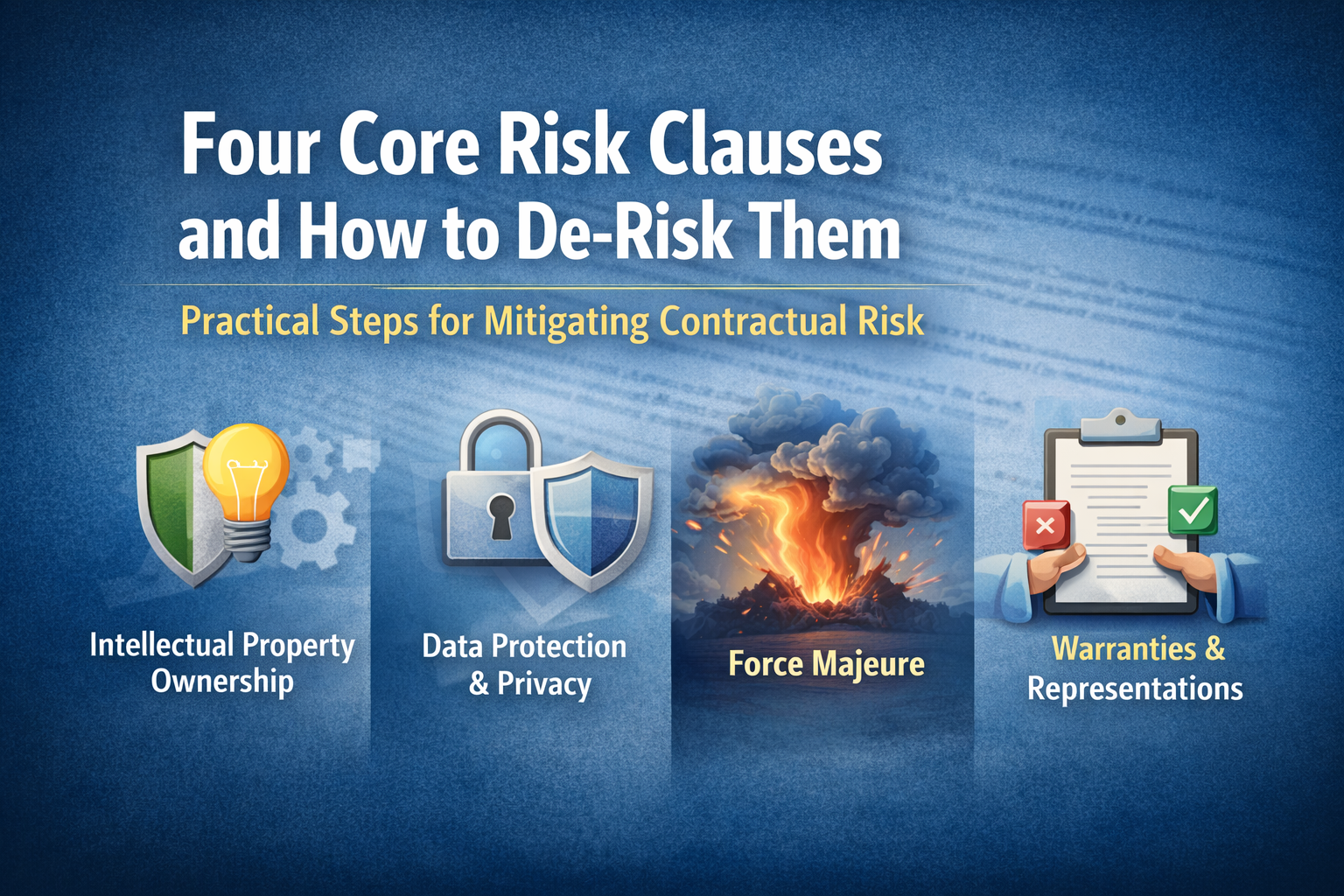
In a previous post, we looked at several common clause types that appear in most commercial agreements. In this follow-up, we focus on four core risk clauses that frequently determine how liability and responsibility are handled when issues arise.
For each clause, we’ll briefly explain what it does, highlight the risks it can create, and outline practical ways to reduce those risks during drafting and contract review.
Intellectual Property Ownership
What it does
Intellectual property (IP) ownership clauses define who owns the IP associated with the contract, including any work product, inventions, software, or other materials created under the agreement. These provisions are especially important in technology, consulting, development, and licensing agreements where new IP may be created.
What’s the risk?
Unclear IP ownership terms can lead to disputes over who controls the work product, whether either party can reuse it, and how it can be commercialized in the future. If ownership is not clearly defined, a party may lose the ability to use or modify critical materials, or face claims that it is infringing the other party’s rights.
Typical provisions
- Assignment of newly created work product to one party
- Retention of each party’s pre-existing IP (“background IP”)
- License rights allowing one party to use the other party’s IP for specific purposes
- Restrictions on reuse, modification, or distribution of the work product
- Clarification of ownership for jointly developed materials
How to de-risk it
Clearly distinguish between pre-existing IP and any new work product created under the agreement. Specify whether new materials are fully assigned to one party or licensed for certain uses, and ensure those rights align with how the work product will be used after the project ends. Confirm that related provisions, such as confidentiality, data rights, or license restrictions, do not conflict with the ownership structure described in the clause.
Data Protection & Privacy
What it does
Data protection and privacy clauses establish how the parties must handle personal or sensitive data under the agreement. These provisions define responsibilities for collecting, processing, storing, and protecting data, particularly when one party processes data on behalf of the other as a service provider.
What’s the risk?
Improper handling of personal data can expose parties to regulatory penalties, contractual liability, and reputational harm. Ambiguous privacy provisions may also create uncertainty about who is responsible for compliance with data protection laws, breach notification obligations, or security requirements.
Typical provisions
- Compliance with applicable data protection laws (e.g., GDPR, CCPA)
- Restrictions on how personal data may be processed or used
- Security requirements for storing and protecting data
- Obligations to notify the other party of data breaches
- Limits on cross-border data transfers
How to de-risk it
Clearly define each party’s role in handling data, particularly whether a party is acting as a data controller or processor. Specify the security measures required to protect sensitive information and outline clear breach notification obligations. Confirm that the clause aligns with applicable privacy regulations and any separate data processing agreements, and ensure that data handling responsibilities are consistent with confidentiality and information security provisions elsewhere in the contract.
Force Majeure
What it does
Force majeure clauses address situations where extraordinary events beyond a party’s control prevent it from fulfilling its contractual obligations. These provisions define which events qualify and specify how the parties’ obligations change when those events occur.
What’s the risk?
Without clear force majeure language, parties may face disputes about whether performance can be delayed or excused during disruptive events. Overly broad clauses may allow a party to avoid obligations too easily, while overly narrow clauses may fail to protect parties during genuine disruptions such as natural disasters, geopolitical conflicts, or major supply chain interruptions.
Typical provisions
- Natural disasters such as earthquakes, floods, or hurricanes
- War, terrorism, or civil unrest
- Government actions, sanctions, or regulatory shutdowns
- Labor strikes or major supply chain disruptions
- Temporary suspension of obligations while the event continues
How to de-risk it
Define qualifying force majeure events clearly and avoid vague language that could excuse routine business difficulties. Require prompt notice when a party invokes the clause and specify the steps the affected party must take to mitigate the disruption. Establish limits on how long performance may be suspended before termination rights arise, and confirm that the clause aligns with related provisions such as termination and service level commitments.
Warranties & Representations
What it does
Warranties and representations are statements of fact that each party makes about itself, the agreement, or the underlying transaction. They help establish a baseline of trust by confirming key facts that the other party relies on when entering the agreement.
What’s the risk?
If a representation or warranty turns out to be inaccurate, the affected party may claim breach of contract and seek damages, termination rights, or indemnification. Overly broad or poorly defined warranties can expose a party to liability for issues outside its control, while vague language can create disputes about what was actually promised.
Typical provisions
- Each party has the authority to enter the agreement
- The agreement does not violate other contractual obligations
- Intellectual property used in the agreement does not infringe third-party rights
- Products or services will meet agreed specifications
- Compliance with applicable laws and regulations
How to de-risk it
Tailor warranties and representations carefully to the scope of the agreement and the information you can reasonably confirm. Limiting statements with knowledge qualifiers (for example, “to the best of the party’s knowledge”) can prevent unintended liability, while aligning warranties with other provisions, such as indemnification or limitation of liability, helps ensure the contract’s risk allocation remains consistent. Clear definitions and careful review of cross-references are also important to avoid contradictions or unintended obligations.
Conclusion
Risk allocation clauses often receive less attention than operational provisions when agreements are first drafted. But when disputes arise, these are the clauses that frequently determine how responsibility — and liability — are ultimately assigned.
Carefully reviewing provisions such as warranties and representations, intellectual property ownership, force majeure, and data protection can help ensure that the contract reflects the parties’ actual expectations and that risk is allocated clearly and consistently throughout the agreement. Even small inconsistencies in definitions, cross-references, or obligations can create unintended exposure.
In the next post in this series, we’ll look at four additional clauses that play an important role in managing contractual risk.
And if you’re looking for ways to review contracts more efficiently and reliably catch risky issues such as inconsistent language, broken references, or drafting errors before they become problems, schedule a demo of BoostDraft to see how it can streamline contract review directly inside Microsoft Word.
Recent Post